CSV to Lakehouse: An Evolution of Modern Data Architecture
CSV to Lakehouse: An evolution in data architecture
Data architecture has come a long way — from humble spreadsheets and flat files to powerful, cloud-native systems capable of handling petabytes of data.
Understanding this evolution isn’t just about following trends; it’s about choosing the right tools for your use case and scaling efficiently. This guide walks through the major stages of modern data architecture, showing what each step offers — and when it might make sense.
Humble origins: Data in the filing cabinet era
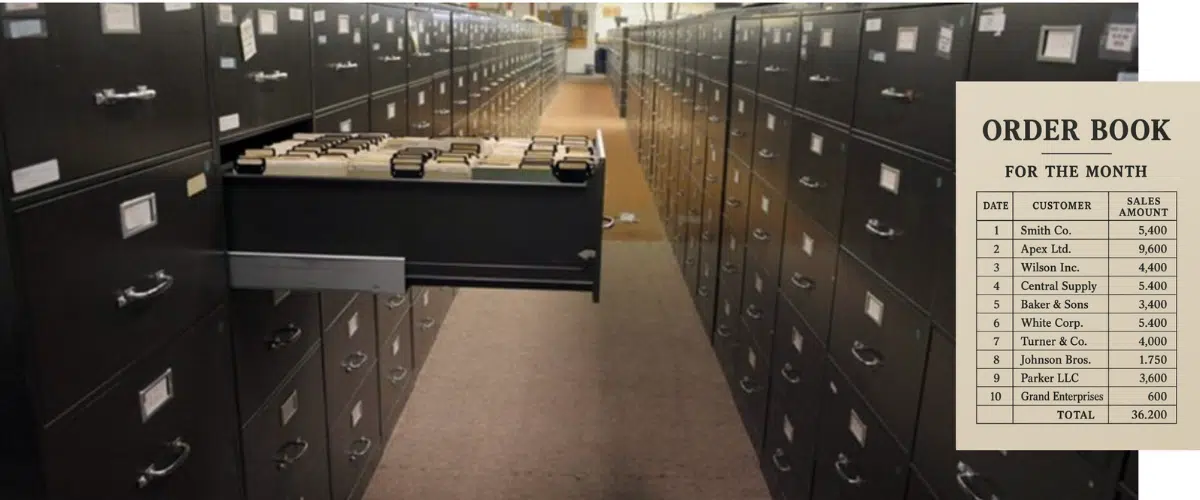
Imagine walking into a massive records room lined with steel filing cabinets. That was data storage in the late 20th century — literal folders, literal files. In 1898, Edwin G. Seibels introduced the vertical filing system to manage business records more efficiently.
Fast-forward to the present: we’re managing petabytes of data not in drawers, but in the cloud. Still, the logic of that filing cabinet persists today — in how we sort, store, and retrieve data. And like our storage technologies, our responsibilities as analysts have evolved.
This guide walks you through the shift from flat files to warehouse and lakehouse paradigms — and how each approach impacts your day-to-day work and long-term analytics success.
The starting point: CSV and Excel
CSV and Excel files have long been the go-to starting point for storing and sharing structured data. They’re easy to generate, simple to open on any machine, and work well for limited datasets. But as data grows — in both volume and complexity — these formats quickly become inefficient.
Large CSV files must be read from beginning to end for even the smallest queries, which slows down processing. There’s no concept of indexing, so sorting or filtering data requires scanning the whole file. As a result, analytics teams often face long load times, memory errors, and difficulties managing file versioning.
Bottom line: CSVs and spreadsheets are accessible, but not built for large-scale analytics or operational reliability.
Better organisation: Partitioning flat files
To improve performance before moving to full-scale databases, many teams adopt partitioning — breaking down a dataset into smaller, more manageable pieces. For example, instead of storing one massive file with all your sales data, you might separate the data into folders by customer and year:
This structure allows analytics tools to read only the subset of files they need, dramatically reducing query time. It also makes storage more organised and intuitive. Combined with naming conventions and automation, partitioning helps stretch the limits of file-based systems before higher investments are needed.
Benefit: Partitioning reduces unnecessary data reads, shortens processing time, and simplifies access for commonly queried data dimensions.
Step up: The Data Warehouse
When flat files and folders can’t keep up with performance demands, many organizations move to a data warehouse. Warehouses like Snowflake, BigQuery, Redshift, and Synapse are designed for speed, structure, and stability.
They require that data be cleaned, transformed, and modeled before loading — a process known as ETL (Extract, Transform, Load). Once the data is inside, users can run complex SQL queries with lightning speed.
Key features include indexing (which allows for fast filtering and joins), query caching (to avoid redundant calculations), and strict schema enforcement (ensuring data consistency). Warehouses are excellent for business intelligence dashboards and standardized reporting.
Trade-offs: While performance is excellent, costs can be high — especially with large user bases or frequent queries — and flexibility is limited for raw or evolving data.
The flexible option: Data Lakes
As companies began collecting more diverse types of data — logs, images, sensor feeds — a new approach emerged: the data lake.
A data lake is simply a central repository for storing raw data in its native format. This might include CSVs, JSON files, Parquet files, images, or even video. Data lakes typically use scalable cloud storage like AWS S3 or Azure Blob Storage.
Lakes are cost-effective and highly scalable. They allow you to store everything — even if you’re not ready to analyse it yet. But because lakes lack structure and indexing, querying data directly from a lake can be slow and inefficient. Without strong governance, data lakes can quickly devolve into “data swamps.”
Best use: When you need a flexible, low-cost way to store large volumes of raw data — especially unstructured data.
The modern balance: Data Lakehouse
The Lakehouse architecture combines the best aspects of data lakes and warehouses. It uses cloud object storage to keep costs low, but layers on key data management features like schema enforcement, ACID transactions (safe inserts, updates, deletes), time travel (querying past versions), and unified analytics access for both SQL and machine learning tools.
Popular implementations include Databricks’ Delta Lake and open standards like Apache Iceberg. With a Lakehouse, you can ingest raw data, transform it, and serve analytics — all from the same storage layer. This reduces duplication and simplifies your data pipeline.
Advantage: Lakehouses provide a single platform for raw, curated, and modelled data — supporting diverse teams without overpaying for high-cost compute.
An open table format for the Lakehouse era
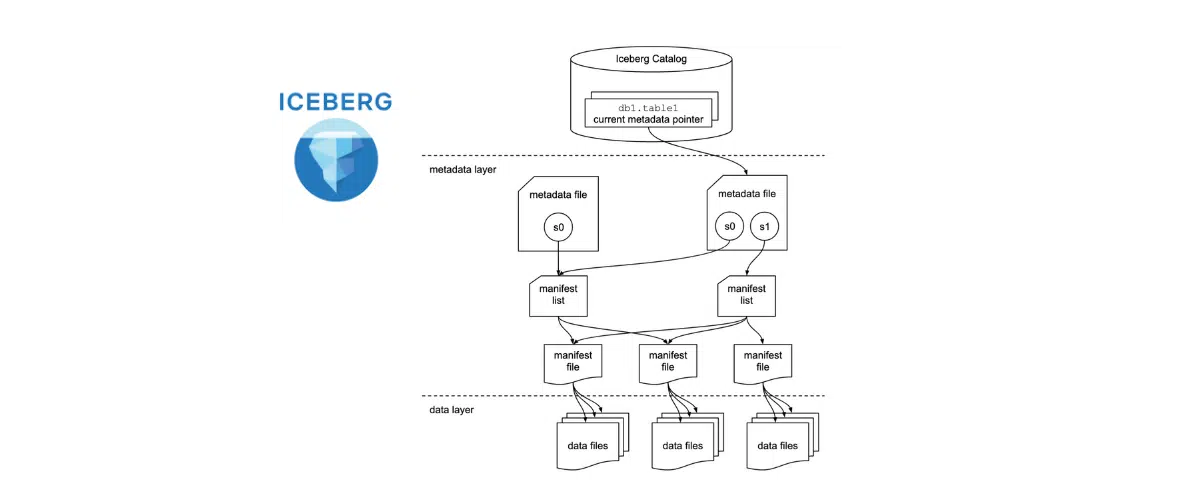
Apache Iceberg is an open table format designed to work with large-scale datasets stored in data lakes. It doesn’t store the data itself — it defines how the data is organised and how metadata is managed. Iceberg supports advanced features like ACID compliance, schema evolution, partition pruning, and time travel.
What makes Iceberg powerful is its broad compatibility. It works with tools like Apache Spark, Trino, Flink, Hive, Qlik, Databricks, and Snowflake — allowing teams to use the right engine for the right job without being locked into a vendor.
However, Iceberg is not ideal for all scenarios. For small or simple datasets, its metadata overhead may be unnecessary. And if you’re already invested in a tightly coupled ecosystem like Databricks Delta Lake, migrating to Iceberg might not provide significant return on investment.
Why it matters: Iceberg offers an open, scalable way to bring database-like features to your data lake without giving up flexibility.
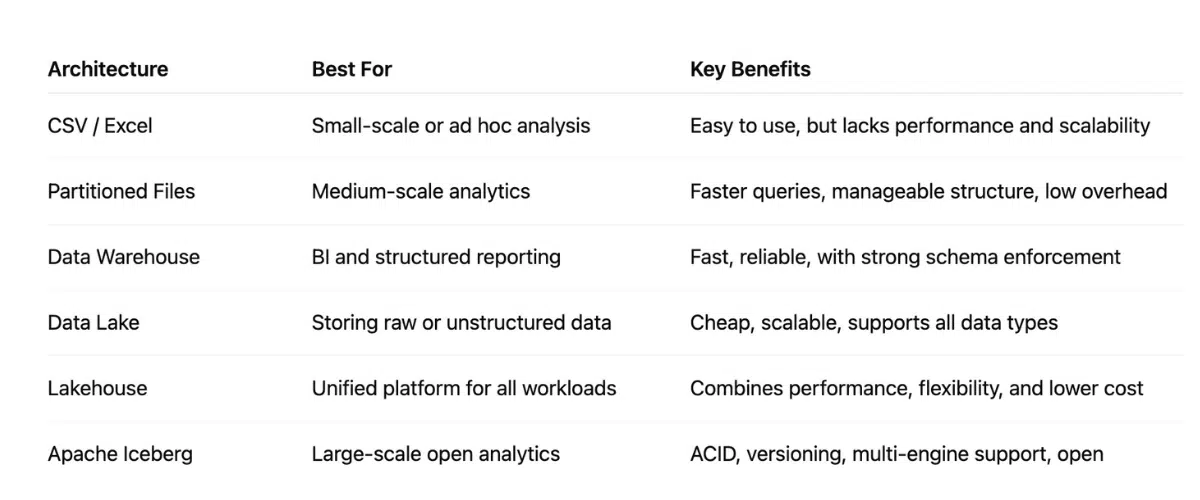
In summary: Choose the right tool for the job
Further reading
Explore more on the technologies and frameworks mentioned in this article:
Qlik Blog: Embracing Iceberg for Scalable, Open Data Solutions
Ready to optimise your data strategy?
Connect with us to explore how we can help.